
Choosing a Lithium Ion Car Battery requires more than comparing capacity and price. Vehicle design, charging systems, climate, and safety requirements all influence the correct choice. The International Energy Agency reported nearly 14 million electric car sales worldwide in 2023. That growth has increased demand for dependable, well-engineered battery systems. Yet popularity does not make every lithium battery suitable for every vehicle.
Start with the battery’s chemistry. Lithium iron phosphate, or LFP, usually offers strong thermal stability and long cycle life. Nickel-manganese-cobalt cells can provide higher energy density, but they require careful thermal management. BloombergNEF’s 2024 Battery Price Survey placed the average lithium-ion pack price at 115 dollars per kilowatt-hour. Lower prices are encouraging, but cost alone cannot prove quality. A cheap pack may hide weak cells, limited protection, or poor documentation.
Check voltage, usable capacity, cold-cranking requirements, dimensions, terminals, and communication protocols. Confirm compatibility with the vehicle’s alternator, charger, battery-management system, and warranty terms. Standards such as ISO 12405 and UL 2580 offer useful reference points, but certification details still need verification. A battery can fit the tray and still fail electronically. That mistake is easy to make.
Real-world conditions matter. A vehicle parked outdoors at minus 10 degrees Celsius may behave differently from one tested in a warm workshop. Service history also matters, although sellers may not provide complete data. There is no universal best battery. The safest decision combines verified specifications, professional installation, transparent test results, and realistic driving needs. Even this approach has limits, so recheck every critical figure before purchase.
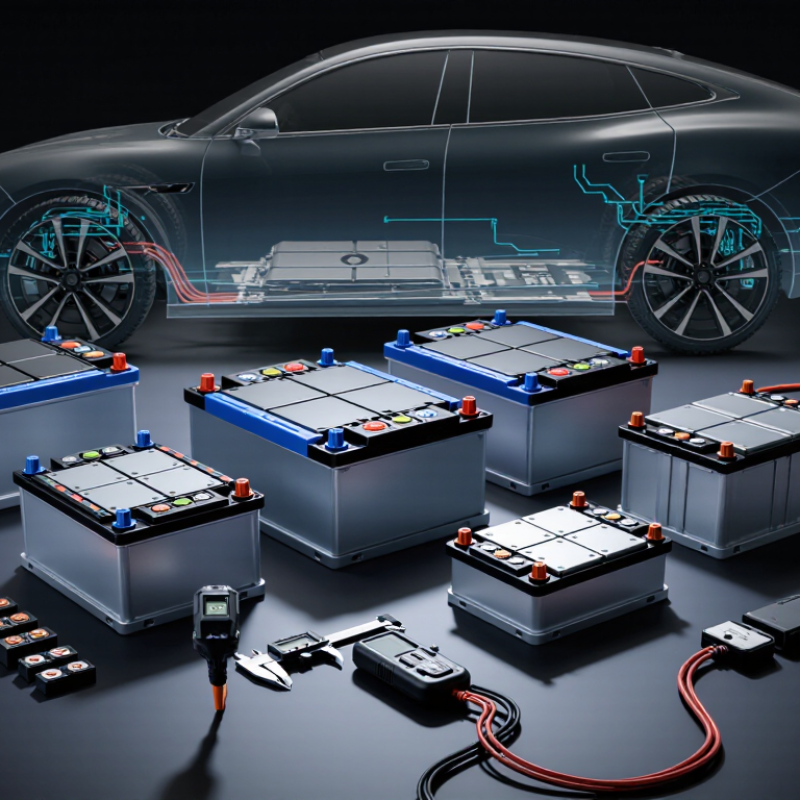
Lithium-ion car batteries are not one uniform product. Their chemistry, voltage, capacity, and cooling design determine where they work best. Lithium iron phosphate, or LFP, offers strong thermal stability and long cycle life. It suits many electric vehicles and energy storage systems. Nickel-rich chemistries, including NMC and NCA, usually provide higher energy density. They can support longer driving ranges, but temperature control becomes more demanding. Lithium titanate, or LTO, charges quickly and handles frequent cycling well. Its lower energy density can increase pack size and cost.
Application matters more than chemistry alone. A 12-volt lithium battery may power accessories or replace a conventional starter battery. A 48-volt system can support mild-hybrid functions and electrical equipment. High-voltage battery packs drive fully electric vehicles and require carefully managed modules, sensors, and cooling channels. Do not confuse a starting battery with a traction battery. Their electrical demands are very different.
Check the vehicle’s approved voltage, terminal layout, battery management system, and charging limits. A battery with impressive capacity may still fit poorly or communicate incorrectly with the car. In cold weather, charging restrictions can become important. Real use exposes weaknesses. A short urban trip, repeated fast charging, and a hot parking area create different stresses. Specifications help, but they never tell the whole story. Even experienced technicians can overlook software compatibility or installation space. That deserves a second check.
Choosing a lithium-ion car battery starts with vehicle compatibility, not capacity alone. Confirm the vehicle’s nominal voltage, battery group size, terminal arrangement, and required cold-cranking current. A battery may fit the tray yet fail because its terminals face the wrong direction. Measure the tray, including hold-down clearance and cable reach.
Check how the vehicle charges. Some charging systems maintain a voltage that suits lead-acid batteries but stresses lithium cells. Others use smart charging, regenerative braking, or battery-management communication. The replacement battery must tolerate that charging pattern. Its internal battery-management system should protect against overcharge, deep discharge, excessive current, and unsafe temperatures. Never assume a higher amp-hour rating is automatically better.
Review the vehicle manual and the battery’s technical sheet together. Look for charging voltage limits, peak starting current, reserve capacity, and acceptable operating temperatures. Electrical accessories matter too. Heated seats, alarms, audio equipment, and frequent short trips can increase the demand. I once focused on physical fit and overlooked cable length; the installation worked, but the connection was awkward and needed correction. That mistake still influences my checks.
Test the charging voltage with a suitable meter, both at idle and under load. Inspect ground connections and the main fuse. A weak ground can look like a defective battery. If the vehicle requires registration or battery-sensor calibration, follow the manufacturer’s procedure or ask a qualified technician. Small details matter.
Choosing a lithium-ion car battery starts with usable capacity, measured in kilowatt-hours (kWh). A larger pack usually provides more range, but it also adds weight, cost, and charging time. At 16–20 kWh per 100 kilometers, a 60 kWh usable battery may deliver roughly 300–375 kilometers in moderate conditions. Cold weather, highway speed, heating, and battery aging can reduce that figure sharply. The International Energy Agency reported global electric-vehicle battery demand above 750 GWh in 2023, showing how quickly this technology is scaling.
Power output deserves separate attention. Capacity tells you how far the car may travel; output determines acceleration, hill-climbing, and towing ability. Compare continuous power, not only a brief peak figure. Thermal management matters here. A battery may feel strong for one acceleration run, then limit power when its cells become cold or hot. That detail is easy to miss. I would question any specification that excludes temperature, state of charge, or testing conditions.
Charging performance depends on both the battery and the charger. A 150 kW connection does not guarantee 150 kW throughout the session. Most vehicles taper charging near a high state of charge, so the 10–80% time is more useful than the maximum figure. The IEA’s Global EV Outlook 2024 recorded over four million public charging points worldwide, with public charging stock growing about 40% during 2023. Still, daily convenience depends on local access. Check charging curves, cold-weather behavior, warranty retention, and usable capacity rather than chasing the biggest number.
Choosing a lithium-ion car battery starts with safety, not the lowest price. Look for a battery-management system that monitors temperature, voltage, and cell balance. Thermal protection and physical shielding matter after a collision. UN 38.3 testing supports safe transport, while ISO 6469 addresses electric-road-vehicle safety. These standards do not guarantee perfect performance. Installation quality still matters.
Lifespan depends on climate, charging habits, and daily use. The U.S. Department of Energy reports expected battery life of about 12–15 years in moderate climates, but only 8–12 years in harsher conditions. Frequent fast charging may increase heat exposure. It is convenient, but not always gentle. Ask for usable capacity, expected degradation, and independent test evidence. Warranty terms deserve close reading. Check both years and mileage, plus the capacity-retention threshold. A replacement promise can sound strong until exclusions appear.
Tips: Compare total ownership cost, not only the purchase price. BloombergNEF’s 2024 Battery Price Survey reported an average lithium-ion pack price of 115 dollars per kilowatt-hour. This is a market benchmark, not a consumer replacement quote. Add labor, cooling components, charger compatibility, and disposal costs. Request a written warranty and battery health report. If the seller avoids clear answers, pause. That hesitation may be useful evidence.
How to Choose a Lithium Ion Car Battery?
Choosing a lithium-ion car battery starts with the vehicle’s electrical design, not online price. The International Energy Agency reported nearly 14 million electric cars sold globally in 2023. That growth makes correct battery selection more important. Check voltage, usable capacity, physical dimensions, connector type, cooling method, and battery-management compatibility. A battery with higher capacity may still fail if its software cannot communicate with the vehicle.
Plan installation with a qualified high-voltage technician. The U.S. Department of Energy identifies battery-management systems as essential for monitoring voltage, temperature, and state of charge. Ask the installer to inspect insulation, crash sensors, cooling lines, mounting points, and diagnostic codes. The technician should follow the vehicle service procedure and document battery condition before removal. Disconnecting a high-voltage pack is not a casual garage task.
Safety matters.
The National Highway Traffic Safety Administration warns that damaged lithium-ion batteries can create delayed fire risks after severe impacts. Therefore, do not install a pack with swelling, crushed cases, corrosion, or unknown repair history. A professional can perform isolation testing and verify post-installation performance. I would not trust a perfect fit alone. Installation quality depends on calibration, torque settings, protective covers, and a controlled final test. Even industry guidance has limits, so rechecking assumptions remains sensible.
| Selection Dimension | Recommended Specification or Range | Why It Matters | Professional Installation Check |
|---|---|---|---|
| Battery Application | 12-volt starting battery, auxiliary battery, or high-voltage traction battery | These applications use different electrical systems, safety procedures, and battery designs. | Confirm the vehicle system voltage and battery function before ordering. |
| Battery Chemistry | Lithium iron phosphate (LiFePO4) is commonly selected for many 12-volt applications; other lithium chemistries may be used in vehicle-specific systems. | Chemistry affects thermal stability, weight, usable capacity, charging requirements, and service life. | Verify that the chemistry is approved for the vehicle’s charging system and installation location. |
| Nominal Voltage | Use a battery with the same nominal voltage as the original system; a typical 12-volt lithium battery has a nominal voltage near 12.8 volts. | Incorrect voltage can damage electronic modules, charging components, or the battery itself. | Measure system voltage and inspect the vehicle service documentation. |
| Physical Size and Terminal Layout | Match the original battery tray, case dimensions, terminal positions, terminal type, and hold-down arrangement. | A battery that does not fit securely may experience vibration, cable strain, or accidental short circuits. | Check length, width, height, polarity, clearance, mounting hardware, and cable reach. |
| Starting Current | Select continuous and peak discharge ratings that meet or exceed the vehicle manufacturer’s starting requirements. | Starting engines require brief, high-current output, especially in cold weather or with high-compression engines. | Compare the battery’s tested cold-cranking or starting-current rating with the original specification. |
| Capacity | For 12-volt systems, choose an amp-hour capacity equal to or greater than the original battery unless the vehicle manufacturer specifies otherwise. | Capacity affects reserve time for lighting, security systems, accessories, and repeated starting cycles. | Check the vehicle’s energy-management settings and confirm that the replacement capacity can be registered if required. |
| Battery Management System | Choose an integrated BMS with overcharge, over-discharge, over-current, short-circuit, and temperature protection. | The BMS monitors cell conditions and helps prevent operation outside safe limits. | Confirm BMS compatibility with the vehicle, charger, diagnostic system, and accessory loads. |
| Charging Compatibility | Use a lithium-compatible charging profile where required; do not assume that every lead-acid charger is suitable. | Charging voltage, current, temperature limits, and balancing behavior vary by battery design. | Test alternator output, DC-to-DC charging equipment, smart charging controls, and parasitic loads. |
| Low-Temperature Operation | Select low-temperature charge protection or an approved heating system if the vehicle operates in freezing conditions. | Many lithium batteries must not be charged below 0°C unless the design specifically permits it. | Confirm the battery’s charge and discharge temperature limits and inspect heater controls where fitted. |
| Operating Temperature | Choose a battery rated for the expected under-hood, cabin, trunk, or battery-compartment temperature range. | Excessive heat can accelerate aging, while very low temperatures can reduce available power. | Evaluate ventilation, heat shielding, moisture exposure, and distance from exhaust components. |
| Vehicle Electronics | The battery must support start-stop functions, security systems, memory circuits, sensors, and other continuous loads. | Some modern vehicles require battery monitoring, energy-management resets, or battery registration after replacement. | Scan for fault codes, test communication systems, and complete any required battery-management reset. |
| Safety Features | Look for enclosed cells, insulated terminals, secure casing, current protection, and documented safety testing. | Safe construction reduces the risk of short circuits, overheating, vibration damage, and improper handling. | Inspect cable insulation, terminal covers, fuse protection, mounting security, and polarity before connection. |
| Weight and Efficiency | A lithium battery may weigh substantially less than an equivalent lead-acid battery, but the actual reduction depends on capacity and construction. | Lower weight can improve installation handling and, in some applications, reduce vehicle mass. | Ensure the lower mass does not compromise mounting stability or crash-safety requirements. |
| Installation and Service | Use a qualified technician for vehicle-specific installation, especially for high-voltage systems or modified charging circuits. | Incorrect installation can cause electrical faults, thermal events, component damage, or personal injury. | Request a pre-installation inspection, electrical test, secure mounting, final voltage check, and written service record. |
| Warranty and Documentation | Choose a battery supplied with a clear warranty, installation instructions, charging limits, safety data, and recycling guidance. | Complete documentation supports safe operation and helps resolve compatibility or service issues. | Keep the invoice, test results, battery specifications, and installation date for future maintenance. |